Today’s currency exchange rates in Pakistan
Open market rates today
| CURRENCY | BUYING | SELLING | CHANGE (24H) |
|---|---|---|---|
| US Dollar USD — US Dollar | 278.20 | 280.30 | 0.23fell |
| Saudi Riyal SAR — Saudi Riyal | 73.90 | 74.50 | 0.03fell |
| UAE Dirham AED — UAE Dirham | 75.60 | 76.40 | 0.03fell |
| British Pound GBP — British Pound | 375.10 | 378.30 | 1.66fell |
| Euro EUR — Euro | 320.50 | 323.70 | 0.81fell |
| Kuwaiti Dinar KWD — Kuwaiti Dinar | 898.739 | 902.883 | 0.81fell |
| Qatari Riyal QAR — Qatari Riyal | 76.14 | 76.48 | 0.03fell |
| Omani Rial OMR — Omani Rial | 720.650 | 723.682 | 0.52fell |
| Canadian Dollar CAD — Canadian Dollar | 198.50 | 203.00 | 0.51fell |
| Australian Dollar AUD — Australian Dollar | 197.20 | 201.00 | 0.12rose |
Send money to Pakistan
Licensed exchange companies by city
Open market and interbank rates explained
Pakistan effectively runs two currency markets, and the rate you get depends on which one you are standing in. The interbank rate is the wholesale price at which commercial banks trade dollars with each other — the State Bank of Pakistan publishes its own figure for it daily — and it is the rate that applies to letters of credit, imports and most bank remittances. The open market rate is the retail price quoted by licensed exchange companies for cash — the rate that matters if you are buying dollars for travel, paying a university deposit, or selling riyals brought home from the Gulf.
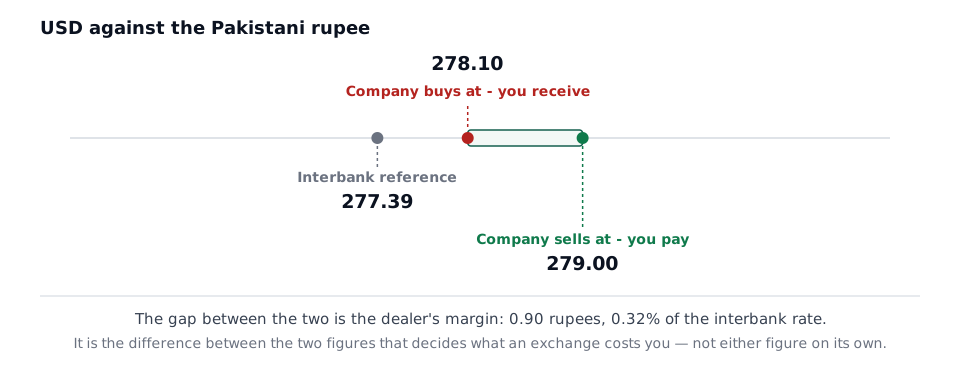
The open market rate normally sits above interbank because it carries the dealer’s cash handling cost and spread, and the gap widens when demand for physical dollars rises. Every dealer quotes two numbers: a buying rate for currency they take from you, and a higher selling rate for currency they hand over. We publish both sides as one national rate, so the spread is visible rather than hidden — and we list the licensed companies and their verified branches across 132 cities separately, so you can find a counter to take it to.
Before you go to a counter
- Bring your original CNIC or passport — exchange companies are required to record it.
- Compare at least three branches; the spread across a single city is routinely 1–2%.
- Ask whether the quoted rate improves above a threshold amount. It often does.
- Confirm the rate before handing over cash, and count the notes at the counter.
SBP currency rules and transaction limits
The State Bank of Pakistan enforces Anti-Money Laundering guidelines and foreign exchange limits on every currency purchase and sale made through a licensed exchange company. What is asked of you differs by direction — buying foreign currency is the tightly controlled side.
Buying foreign currency
Stricter checks, biometric verification and bank-settlement rules.
- 1 Identity verificationValid CNIC, NICOP, POC or passport. A foreign citizen needs a valid visa or entry stamp.
- 2 Biometric verificationNADRA biometric verification at the branch counter is mandatory on every purchase of $500 or above, or the equivalent in another currency.
- 3 Purpose documentationAbove $1,000 you must show supporting evidence — a travel ticket, visa, university invoice or medical assessment.
- 4 Limit undertakingA signed declaration that the purchase stays within the personal limits of $10,000 per day and $100,000 per calendar year, counted across all exchange companies rather than per company.
- 5 Payment settlementUnder $2,000 may be settled in physical rupees. At $2,000 and above, payment must come online or by cheque from the buyer’s own bank account.
- 6 In person, and only in personAuthority letters and third-party purchasing are banned outright. The transaction has to happen physically inside authorised branch premises.
Selling foreign currency
Basic Customer Due Diligence, and a receipt worth keeping.
- 1 Identity verificationValid original CNIC, NICOP, POC or passport.
- 2 Receipt issuanceThe company must issue a sequentially numbered receipt carrying your name, ID number, the rate applied and a transaction stamp.
- 3 Source declarationFor an unusually large cash deposit, a company may ask for proof of source of funds or foreign travel customs receipts, as part of standard AML/CFT procedure.
Limits and thresholds are set by SBP circular and change without notice. Reviewed 10 September 2026 — check the source before acting on a figure. FindMyExchange is not the regulator and does not handle currency.
Common questions
What is the open market rate?
It is the retail price licensed exchange companies quote for physical currency. Unlike the interbank rate it includes the dealer’s cash handling cost and spread, so it is the number that applies when you walk into a shop with cash.
Why does my exchange shop quote a different rate?
Because we publish one national open market rate and your shop publishes its own. Every dealer sets its own margin, and quotes move with local cash demand, the size of your transaction and the denomination you bring — so a counter in Karachi and one in Peshawar will not agree, and neither is obliged to match the figure here. Treat this as a benchmark to negotiate against rather than a price anyone has offered you.
When do rates update?
The open market rate is maintained by our editorial team and revised through the day as the market moves. Every currency carries the time it was last revised, in Pakistan Standard Time, and that timestamp is the honest answer to how current a figure is — a rate is not removed for age, because the last price the market traded at is still the answer to what the rate is, and a blank space is not. Read the timestamp before acting on a number. The reference rate above the table is the global mid-market rate, refreshed automatically every hour from a third-party FX feed — it tracks the interbank rate closely but is not the State Bank of Pakistan’s own figure. SBP’s published interbank rate is shown separately.
What is the difference between buying and selling rates?
Buying is the rate at which the dealer buys currency from you; selling is the higher rate at which the dealer sells it to you. The gap between them is the dealer’s spread, which is why you never get the same rate in both directions on the same day.
Do I need an account to check rates?
No. Rates are public. An account is only needed if you want to set a rate alert, message a branch, or save favourites.
Are these rates official?
No. The reference rate is the global mid-market rate from a third-party FX feed, and the open market figure is a single national rate maintained by our editorial team — indicative of where the market is trading, not a quote from any particular counter. Only the SBP block, where shown, carries the State Bank of Pakistan’s own published figures. Everything here is published for comparison and is not an offer to trade.
How much foreign currency can I legally carry out of Pakistan?
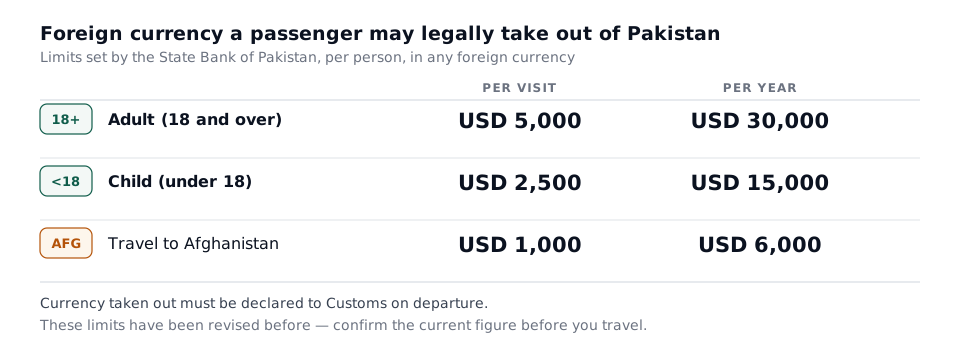
An adult may carry foreign currency equivalent to USD 5,000 per visit, and a child under 18 may carry the equivalent of USD 2,500 per visit. Both also carry an annual ceiling: USD 30,000 a year for adults and USD 15,000 for minors. Travel to Afghanistan is limited separately, at USD 1,000 per visit and USD 6,000 a year. Currency taken out must be declared to Customs on departure. These are State Bank of Pakistan limits and they have been revised before — confirm the current figure before you travel.
What documents do I need to buy foreign currency?
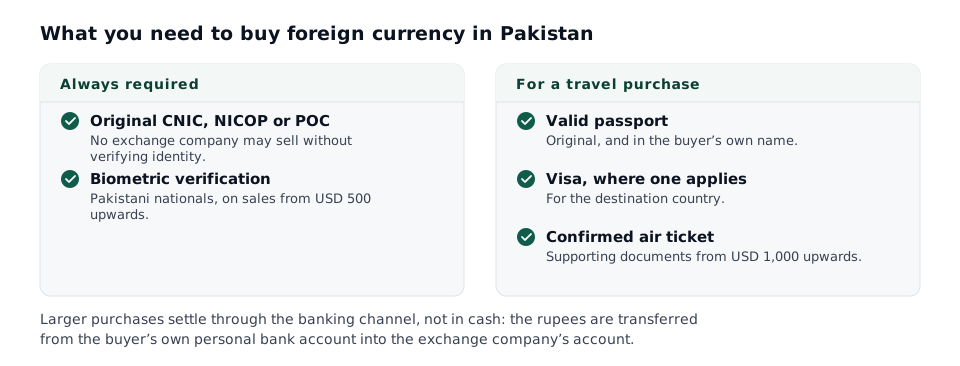
Your original CNIC, NICOP or POC is always required — an exchange company cannot sell you currency without verifying your identity, and biometric verification applies to Pakistani nationals from USD 500 upwards. For a travel purchase you also need documents proving the purpose: a valid passport, the visa where one applies, and a confirmed air ticket. Supporting documents are required on sales from USD 1,000 upwards. Larger purchases are settled through the banking channel rather than in cash — you transfer the rupees from your own personal bank account into the exchange company’s account, which is also why the account must be in the buyer’s own name.